Python ``tensorflow.math.sinh()`` 函数详解与可视化示例
发布日期 :2023-03-06 01:54:29 UTC
访问量: 16 次浏览
Python – tensorflow.math.sinh()
TensorFlow是谷歌设计的开源Python库,用于开发机器学习模型和深度学习神经网络。
sinh()是用来寻找x的双曲正弦元素。
语法: tf.math.sinh(x, name)
参数:
- x:它是输入的张量。这个张量允许的dtype是bfloat16, half, float32, float64, complex64, complex128。
- name(可选):它定义了操作的名称。
返回:它返回一个与x具有相同dtype的张量。
示例 1:
# Importing the library
import tensorflow as tf

# Initializing the input tensor
a = tf.constant([1, 2, 3, 4, 5], dtype = tf.float64)

# Printing the input tensor
print('Input: ', a)

# Calculating tangent
res = tf.math.sinh(x = a)

# Printing the result
print('Result: ', res)
输出:
Input: tf.Tensor([1. 2. 3. 4. 5.], shape=(5, ), dtype=float64)
Result: tf.Tensor([ 1.17520119 3.62686041 10.01787493 27.2899172 74.20321058], shape=(5, ), dtype=float64)
例子2: 视觉化
# importing the library
import tensorflow as tf
import matplotlib.pyplot as plt

# Initializing the input tensor
a = tf.constant([1, 2, 3, 4, 5], dtype = tf.float64)

# Calculating tangent
res = tf.math.sinh(x = a)

# Plotting the graph
plt.plot(a, res, color ='green')
plt.title('tensorflow.math.sinh')
plt.xlabel('Input')
plt.ylabel('Result')
plt.show()
输出:
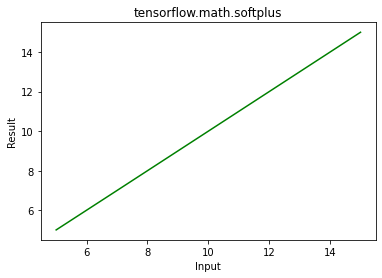 ")
")